
Page Contents
Details: (25) Black Roof Ice Guard Snow Guard Snow Stops for R-Panel PBR and Standing Seam Metal Roofing (No Screws or Adhesive)
Brand: SnoBlox
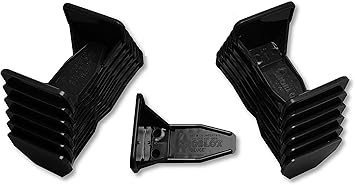
SnoBlox polycarbonate plastic snow and ice guards are colored black the entire way through the guard. From the originators of the polycarbonate snow guard, our products have helped prevent damage from snow and ice avalanches on sloped metal roofs since 1976. This product can be adhesive or screw mounted. Adhesive and Screw kits are available options. Placement of snow guards in isolated areas such as chimneys, doorways, vents and partial roof sections is NOT recommended.

Advantages
- Products can be returned
- Make sure this fits by entering your model number.
- (25) TWENTY FIVE Pack of Snow and Ice guard designed to keep snow and ice off metal roofs.
- Professionally tested guards help prevent injury, property damage and liability claims from releasing sliding snow and ice on metal roofing.
- Roof Snow Guards made to fit in the flat area of a screw down corrugated metal roof with minor ribs that are at least 1.5″ apart.
- Kit Includes 25 Black SnoBlox Deuce (No Adhesive or Screws)
Notice
- Is an online purchase
- Delivery may be delayed in some areas.
Buyer Guide De-Icers & Salt Spreaders
If you’re shopping for a spreader, be sure to consider your needs first.- Size and Weight. Consider where you will store the salt spreader. The spreader’s size will depend on the number of spreaders, but keep in mind the weight too.
- Purpose and Features. What type of spreader are you looking for? What features are important?
- Materials. You want a spreader made of a material that won’t rust or corrode.
- Weight Capacity. The spreader’s weight capacity should be equal to or greater than the weight of the salt, sand, or ice it will hold.
- Warranty. When purchasing a unit, inquire about the manufacturer’s warranty.
How to choose De-Icers & Salt Spreaders
Salt spreaders and de-icers are essential tools to have on hand during the winter months. If you’re worried about getting stuck out in the cold this winter, then read on.- Consider your salt needs. How much salt do you typically need? Salt spreaders and de-icers come in all different shapes and sizes. If you have a small driveway or a small family, a small, handheld de-icer might be the best option for you.
- Is battery life important? Some de-icers can be battery-powered, which can be useful if you’re stuck outside in a snowstorm. However, some battery-powered de-icers aren’t very portable, and using them can be inconvenient.
- Consider which type of salt to use. If you live in an area that has salt brine, then you’ll want to consider keeping a bag of salt brine on hand so you can use it on icy surfaces.
- Do all de-icers require manual activation? Some de-icers require manual activation, while others use motion sensors. Manual activation de-icers can take a little bit of time but require no battery power. Motion sensors require battery power, but you can start them as soon as you step outside.
How to maintain De-Icers & Salt Spreaders
Salt spreaders and de-icers are a great way to get clear, clean roads in the winter. However, if you use these products, its important to keep them clean so they dont accumulate debris or ice.- Rinse the spreader or de-icer. Before each use, rinse the salt spreader or de-icer thoroughly with warm water. Check the manufacturer’s directions for rinsing instructions.
- Wash the spreader or de-icer. After each use, wash the salt spreader or de-icer with warm water and dish soap.
- Dry the spreader or de-icer. After washing, dry the spreader or de-icer.
- Store the spreader or de-icer. Before storing, rinse the spreader or de-icer well with warm water. Then, store the spreader or de-icer.
Related posts:
Review Carburetor Carb Compatible with Ariens Poulan 20001027 20001368 Pro 532436565 532 243 6565 58...
Review (New Part) 1501122MA Replacement Murray SNOWBLOWER Traction Drive Cable 313449MA 1501122MA 31...
Review Snow Shovel, Alum, D-Grip Handle
Review EGO SNT2400 24 in. Self-Propelled 2-Stage Peak Power Battery and Charger Not Included Snow_Bl...

FBIA TEAM
Admin Tle Chubby man who loves technology and the changes in the world around him. (Around Me)