
Page Contents
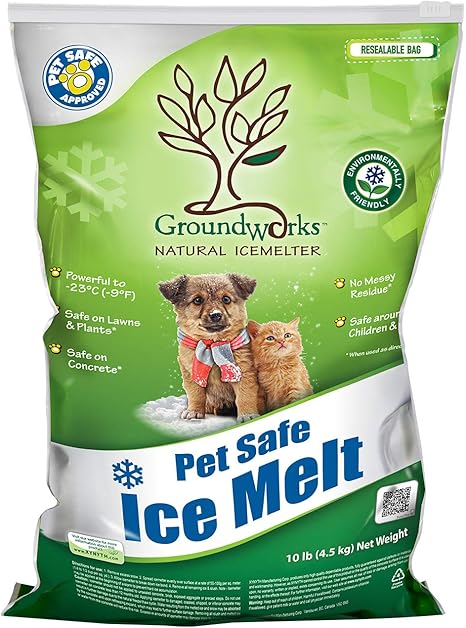
Details: Groundworks All Natural Child Pet Plant and Concrete Safe Fast Acting Ice Melt 10 Pound Bag
Brand: Groundworks Natural

Advantages
- Products can be returned
- Make sure this fits by entering your model number.
- POWERFUL all natural potassium composition melts snow and ice in extremely frigid temperatures as low as -9°F (-23°C). Child, pet, plant and concrete safe. Generates exothermic heat and does not need light to work effectively.
- PREMIUM POTASSIUM a fertilizer and food-based ingredient, highly unlikely to burn pet’s paws or your lawn. DOES NOT CONTAIN MAGNESIUM CHLORIDE which is damaging to concrete! Rock salts are known to burn pet’s paws and lawns!
- SAFEST FOR PETS, LAWNS AND LANDSCAPES. Pet Safe formulation won’t harm plants, also safe for properly set and cured concrete won’t cause spalling on driveways. UREA FREE NO HARMFUL NITROGEN!
- WORKS PERFECT IN SPREADERS. Apply at 1/4 – 1/2 cup per square yard, most competitors application rates are 2 times the amount of GroundWorks Natural Icemelter. Can be use in various ice melt spreaders.
Notice
- Is an online purchase
- Delivery may be delayed in some areas.
Buyer Guide De-Icers & Salt Spreaders
If you’re shopping for a spreader, be sure to consider your needs first.- Size and Weight. Consider where you will store the salt spreader. The spreader’s size will depend on the number of spreaders, but keep in mind the weight too.
- Purpose and Features. What type of spreader are you looking for? What features are important?
- Materials. You want a spreader made of a material that won’t rust or corrode.
- Weight Capacity. The spreader’s weight capacity should be equal to or greater than the weight of the salt, sand, or ice it will hold.
- Warranty. When purchasing a unit, inquire about the manufacturer’s warranty.
How to choose De-Icers & Salt Spreaders
Salt spreaders and de-icers are essential tools to have on hand during the winter months. If you’re worried about getting stuck out in the cold this winter, then read on.- Consider your salt needs. How much salt do you typically need? Salt spreaders and de-icers come in all different shapes and sizes. If you have a small driveway or a small family, a small, handheld de-icer might be the best option for you.
- Is battery life important? Some de-icers can be battery-powered, which can be useful if you’re stuck outside in a snowstorm. However, some battery-powered de-icers aren’t very portable, and using them can be inconvenient.
- Consider which type of salt to use. If you live in an area that has salt brine, then you’ll want to consider keeping a bag of salt brine on hand so you can use it on icy surfaces.
- Do all de-icers require manual activation? Some de-icers require manual activation, while others use motion sensors. Manual activation de-icers can take a little bit of time but require no battery power. Motion sensors require battery power, but you can start them as soon as you step outside.
How to maintain De-Icers & Salt Spreaders
Salt spreaders and de-icers are used to help prevent snow and ice-related accidents, but its important to keep them in tip-top shape so that they can be effective.- Regularly check batteries. Most salt spreaders and de-icers run on batteries or electricity. If you find that the batteries arent holding a charge, you should replace them as soon as possible.
- Check the pressure. Salt spreaders and de-icers use compressed air to propel salt across driveways, but its important to regularly check these hoses to make sure they are in good condition. If you notice that the pressure is dropping, it may be time to replace the hose.
- Clean the salt spreader. Salt spreaders and de-icers can get quite dirty, especially if you are regularly using them. It is a good idea to clean the salt spreader after each use, especially if it has been used in the winter.
- Check the blades. Salt spreaders and de-icers use metal blades to cut through the snow and ice. If the blades become dull, they may not be able to cut through the ice as effectively as they should. It is a good idea to periodically sharpen the blades.
- Check the engine. Salt spreaders and de-icers need to be hooked up to a power source. If you find that your spreader or de-icer is not adequately powering on, you should replace it.
Related posts:
Review Technology Parts Store Drive Belt 11904 Compatible with Craftsman36 Snow Blower Model 8422406...
Review Meititi Snow Shovel, 47 Inch Portable Snow Shovels with D-Grip, Non-Slip Sponge and Durable A...
Review TUSK Subzero Snow Plow Kit, Winch Equipped ATV, 50" Blade for Polaris Sportsman ACE 900 2016
Review Car De-icer Spray - De-icer Car Windshield Deicer Snow Melting Agent,Snow Melting Agent Auto ...

FBIA TEAM
Admin Tle Chubby man who loves technology and the changes in the world around him. (Around Me)